 Est. 1537 · For everyone who stays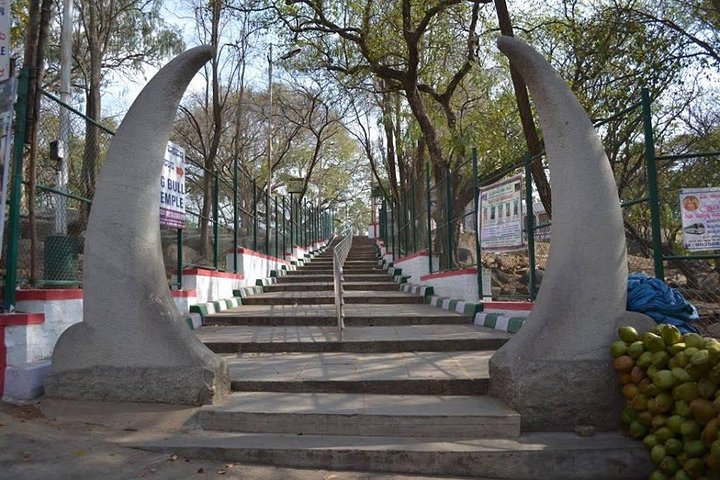
ಬಸವನಗುಡಿ
Basavanagudi.
Temple bells, bookshops and breakfast queues — old Bengaluru still gathers here every morning.
How it got its nameಇತಿಹಾಸ
The name is literal: Basava means bull, gudi means temple — the neighbourhood takes its identity directly from the Dodda Basavana Gudi, a 16th-century temple housing a monolithic Nandi carved from a single granite boulder. Before the suburb arrived, this land was the agricultural village of Sunkenahalli, famous for its groundnut fields and fruit groves. When the bubonic plague of 1898 forced the city to plan beyond its congested Pete areas, Dewan K. Seshadri Iyer chose this open land to build a model hygienic extension of broad roads, setback bungalows and temple streets.
Over time Gandhi Bazaar becomes its cultural spine. Flower sellers, music stores, tiffin rooms and bookshops slowly transform the market into one of the city's defining public spaces. Institutions like Vidyarthi Bhavan and MTR evolve from restaurants into living pieces of Bengaluru memory. Philosopher-poet D.V. Gundappa (DVG) builds his home and the Gokhale Institute of Public Affairs on Bull Temple Road, cementing the neighbourhood's identity as the intellectual and literary heart of old Bengaluru.
Even today the neighbourhood feels anchored to ritual. Morning walks through Bugle Rock — a 3-billion-year-old granite outcrop, one of the oldest exposed surfaces on Earth — Carnatic concerts during festival season, and the Gavi Gangadhareshwara Temple's famous Makar Sankranti alignment, where sunset rays pass precisely through Nandi's horns to illuminate the Shivalinga deep within the cave, continue to define Basavanagudi long after the rest of the city has moved on.